
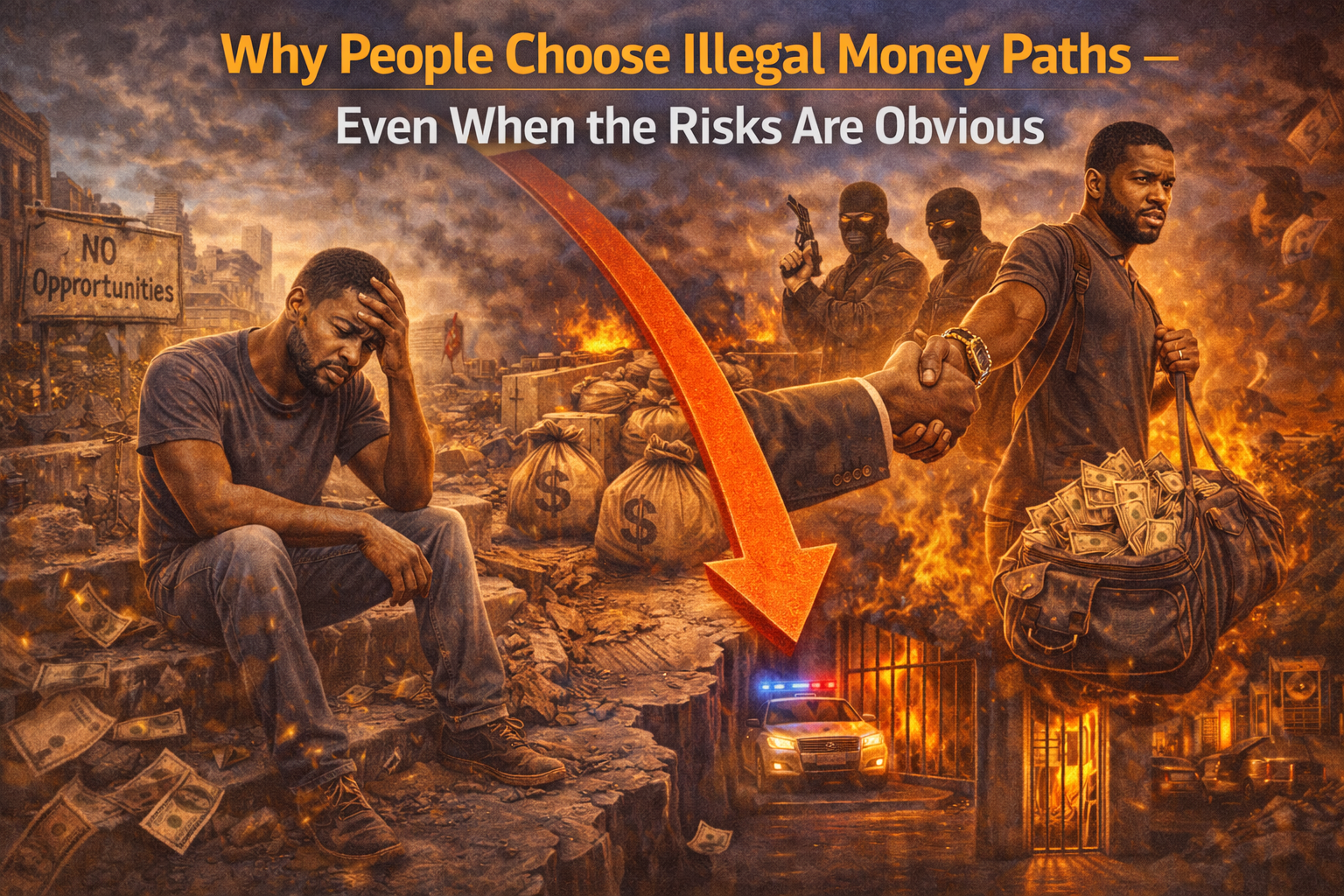
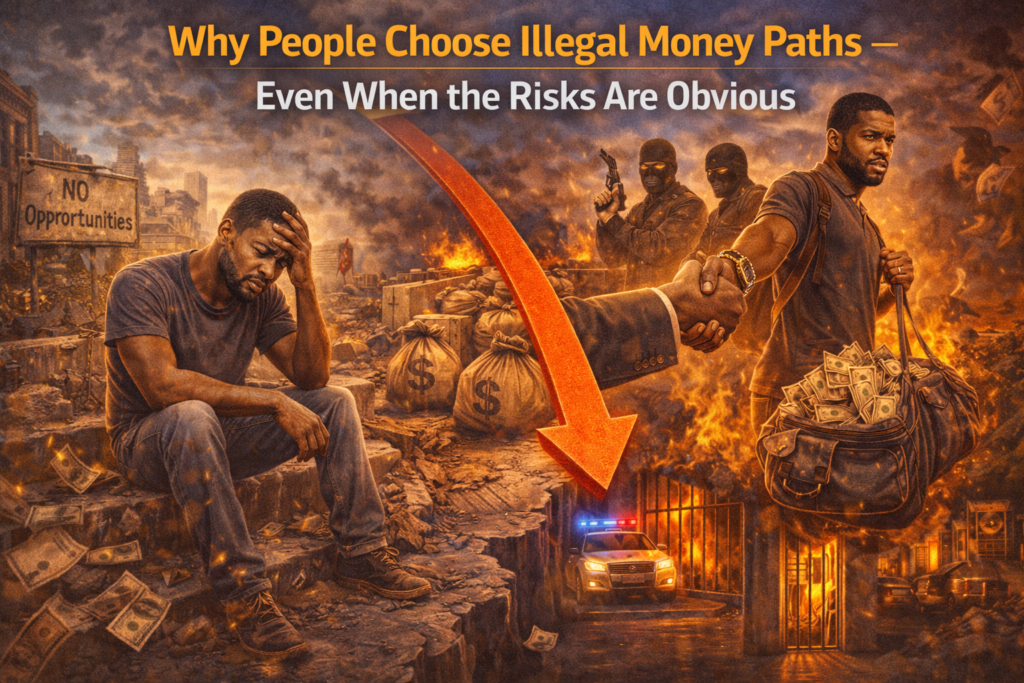
We have seen more young people push beyond boundaries to get the life they desire often at the expense of their freedom, peace of mind, and long-term future.
The economy is hard.
Everyday survival feels heavier than before. Prices rise faster than income, and even when people are “earning well,” the impact of their effort feels invisible.
Salaries that look impressive on paper evaporate after rent, transportation, food, family responsibilities, taxes, and emergencies are deducted.
Business owners generate sales, yet reinvestment, operating costs, and unstable markets leave little to show as personal progress.
Many people try to add extra income streams. Some succeed. Many don’t. Others fail repeatedly until discouragement sets in.
At that point, people branch into two paths: some settle for less and adjust their dreams downward, while others take a dangerous turn to illegal ways of making money. Not because these paths are noble or admirable, but because they pay faster, even if they come with terrifying risks.
- Risks that steal sleep.
- Risks that force constant alertness.
- Risks that turn every knock, call, or delay into fear.
Yet despite knowing the consequences, people keep flooding into illegal activities and the numbers keep rising.
So the question remains:
Why do people move toward illegal ways of making money even when they clearly know the consequences?
Below are 7 deep reasons, followed by practical remedies for each.
1. Economic Pressure and Survival Anxiety
At the core of many illegal decisions is survival fear. When basic needs food, shelter, healthcare, transportation are threatened, morality often takes a back seat to urgency. People don’t wake up dreaming of committing crimes; they wake up calculating how to survive the day.
When legal income cannot meet basic needs, they mind shifts from long-term thinking to short-term survival mode. In this state, consequences feel distant and abstract compared to immediate hunger, debt collectors, or family pressure.
Survival anxiety narrows judgment. It convinces people that “this is just temporary” or “I’ll stop once I stabilize.”
THE REMEDY
Governments and institutions must prioritize living wages, not just minimum wages.
Individuals must focus on reducing financial leakage (unnecessary expenses, lifestyle inflation) alongside income growth.
Communities and families need open conversations about financial hardship so people don’t suffer in silence until desperation pushes them into illegal acts.
2. Delayed Rewards in Legitimate Systems
Legal income systems reward patience. Illegal systems reward speed.
In legitimate work or business, effort today often pays off months or years later. Skills take time. Businesses take time. Promotions take time. Meanwhile, bills are due now.
Illegal activities compress time. The reward is immediate, even if the punishment is delayed. Humans are psychologically wired to prefer immediate rewards over delayed benefits, especially under stress.
This imbalance makes illegal income feel more efficient even when it’s destructive.
THE REMEDY
Promote short-cycle legal income models (freelancing, contract work, digital skills, micro-services).
Teach financial literacy that helps people survive the “waiting period” of legitimate growth.
Build emergency savings even small ones to reduce the temptation of fast illegal money.
3. Social Comparison and Lifestyle Pressure
Social media has changed perception. People now compare behind-the-scenes struggles with other people’s highlight reels.
When peers suddenly “blow up,” buy cars, travel, or live lavishly with no clear explanation, the pressure intensifies.
This creates a dangerous internal dialogue:
“I work hard, but I’m still behind.”
“Everyone else is winning. What am I doing wrong?”
For some, illegal money becomes a shortcut to status restoration. A way to catch up and avoid feeling left behind.
THE REMEDY
Teach financial reality literacy, especially among youth. Success is often delayed, uneven, or funded by debt.
Reduce validation based on appearances and shift toward progress-based self-worth.
Encourage content that highlights the process, not just outcomes.
4. Broken Trust in Systems and Institutions
Many people no longer trust that “doing things the right way” leads to fair outcomes.
They see corruption, favoritism, inequality, and loopholes exploited by powerful individuals who face little consequence.
When the system feels rigged, illegal behavior starts to feel justified: “Why should I play fair when the system doesn’t?”
This mindset doesn’t emerge from rebellion alone. It grows from repeated disappointment and perceived injustice.
THE REMEDY
Institutions must rebuild trust through transparency and accountability.
Individuals should focus on controllable systems—skills, networks, value creation—rather than relying solely on institutions.
Communities should spotlight stories of ethical success to counter the narrative that “crime is the only way.”
5. Limited Access to Opportunity and Education
Not everyone starts from the same position. Some people lack access to quality education, mentorship, capital, or networks.
When legal paths appear blocked or unreachable, illegal ones appear more accessible.
If someone feels excluded from opportunity, they may stop respecting the rules guarding that opportunity.
THE REMEDY
Expand access to practical skill education, not just academic credentials.
Create mentorship pipelines connecting experienced professionals with disadvantaged youth.
Promote low-barrier entry opportunities that allow people to earn legally while learning.
6. Psychological Fatigue and Burnout
Repeated failure, stagnation, and effort without visible progress wear people down. Burnout clouds judgment. It reduces patience. It lowers resistance to risky decisions.
At some point, people stop asking, “Is this right?” and start asking, “Will this work now?”
Illegal income becomes less about greed and more about mental exhaustion.
THE REMEDY
Normalize rest and recovery not just hustle.
Encourage strategic pauses instead of reckless leaps.
Help people redefine success in phases, not all-or-nothing outcomes.
7. The Illusion of Control and Power
Illegal activities often create a false sense of control. People feel powerful because they are no longer waiting for approval, promotions, or permission. They feel in charge of their income.
But this control is fragile. It depends on secrecy, luck, and constant vigilance. Over time, the psychological cost outweighs the financial gain.
THE REMEDY
Teach ethical entrepreneurship as a path to autonomy without fear.
Encourage building systems that provide predictable income, even if smaller at first.
Reinforce that true freedom includes peace of mind, not just cash flow.
Conclusion
People don’t move toward illegal ways of making money because they are ignorant of consequences. They move because the pressure of now feels heavier than the fear of later.
Economic hardship, delayed rewards, social pressure, broken trust, limited opportunity, burnout, and the desire for control all converge to push people into risky decisions. Illegal income becomes a symptom not the disease.
The real solution is not just stricter punishment. It is better systems, better education, better access, and better emotional support.
It is teaching people how to survive the waiting period of legitimate growth without losing themselves.
Fast money can solve a short-term problem, but it often creates a lifetime one.
True wealth is not just money earned. it is freedom without fear, progress without panic, and success that doesn’t require hiding.
Until societies address the root causes, the flood toward illegal income will continue not because people don’t know better, but because they feel they have no better choice.
Ready to go Deeper?
If this helped you see things more clearly, the next step is simple.
On UNSTUCKMYND, you’ll find:
Support Tools (Free): to help you spot opportunities, understand challenges, and make sense of what’s really happening.
Growth Tools (Premium): for when you’re ready to move from clarity to action and take the next step with intention.
Whether you’re just trying to understand your situation or ready to grow beyond it, there’s a place to start.
Explore the tools here:
GLOBAL ACCESS (GUMROAD): CLICK HERE
AFRICAN ACCESS (SELAR): CLICK HERE
Remember Clarity comes first. Growth follows.