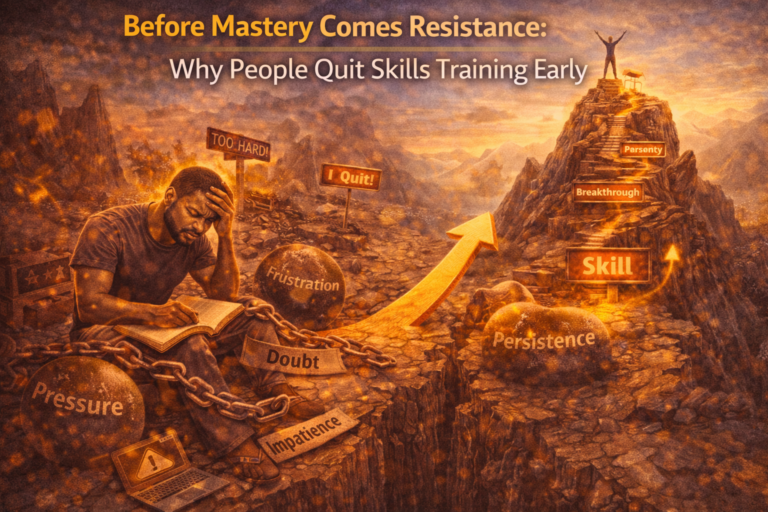


There’s a popular belief that with time, everything falls into place and that consistency always pays off in the long run.
In theory, that sounds comforting. In reality, many people stay consistent for years in their careers or businesses and still feel stuck at the same level.
Days turn into weeks. Weeks turn into months. Years pass. Yet it feels like you’re running in circles. No visible progress. No major breakthrough.
This is when doubt creeps in. You start questioning your decisions, your effort, and even your competence. You wonder where things went wrong or if they ever went right in the first place.
What’s happening isn’t a lack of effort, but a lack of directional growth.
Consistency without alignment doesn’t compound; it just exhausts you. Time alone doesn’t move things forward. Time plus the right inputs does.
Sometimes, it is our fault (without us realizing it)
This is the hardest truth to accept.
Many times, the problem isn’t external. It’s the indirect things we do or fail to do that quietly sabotage progress. We believe we’re doing the right things because we’re busy, disciplined, and committed. But being busy isn’t the same as being effective.
Wrong assumptions, outdated strategies, emotional decisions, and unconscious habits can keep you stuck for years.
And the danger is this: when you repeat the same wrong actions consistently, they start to feel right. Growth doesn’t punish laziness alone it punishes blind consistency.
Why people lose momentum despite years of consistency
Consistency is powerful, but it’s not magic. Without structure, clarity, and adaptability, it can trap people in cycles that look productive on the surface but lead nowhere underneath.
Below are 6 major reasons why people stay consistent for years and still feel stuck—and what to do about each.
1. You don’t have a system
A system is how work gets done even when motivation is low. Without a system, everything depends on mood, urgency, or pressure. That’s unstable.
When you have a system, you can measure progress, identify leaks, and adjust quickly. Without one, you keep repeating mistakes without knowing where things broke.
Example: A business owner posts content daily but has no system for tracking conversions, engagement quality, or customer feedback. They’re consistent but blind.
REMEDY:
Build simple systems:
- A process for acquiring customers
- A method for tracking results
- A review cycle (weekly or monthly)
Systems turn effort into insight. Insight turns effort into growth.
2. Loan taking without strategy
Debt isn’t evil but unmanaged debt is dangerous. Loans taken for ego, urgency, or lifestyle inflation quietly choke growth. Once debt pressure enters, decisions stop being strategic and start being desperate.
Example: A business takes loans to expand before stabilizing cash flow. Profits now go into repayments instead of growth.
Remedy:
- Only take loans that increase earning capacity
- Ensure repayment doesn’t cripple cash flow
- Separate survival loans from growth loans
Debt should buy time or leverage not anxiety.
3. Fast diversification or poor investment decisions
Diversification too early is often disguised confusion. In business, control comes before expansion. The more scattered your focus, the weaker your execution.
Example: A founder runs three businesses that are all average instead of one that’s exceptional.
Remedy:
- Master one market deeply
- Build loyalty and profitability first
- Expand only when systems can run without you
Depth before width always wins.
4. Being at the mercy of inflation and external pressures
Inflation silently taxes those without leverage. When costs rise but income doesn’t, growth reverses.
Example: Prices increase, expenses rise, but pricing strategy stays the same.
Remedy:
- Build pricing flexibility
- Increase value, not just volume
- Invest in skills or assets that scale with inflation
You don’t fight inflation with effort, you fight it with positioning.
4. Fear of the next level
Growth requires discomfort. Many people unconsciously sabotage opportunities because the next level demands responsibility, visibility, or risk. Example: Avoiding delegation because it feels safer to do everything yourself.
Remedy:
- Identify what the next level demands
- Upgrade skills, mindset, and structure gradually
- Accept temporary instability as part of growth
Fear doesn’t stop progress. It delays it.
5. Loss of clarity and purpose (WHY)
When the original reason fades, confusion enters. You keep moving, but without meaning. That drains energy. Example: Working hard without knowing what success actually looks like anymore.
Remedy:
- Revisit your WHY
- Redefine success for your current phase
- Align goals with values, not pressure
Clarity restores momentum.
6. Forgetting value and chasing money
Money follows value, not the other way around. When value creation drops, income becomes unstable. Example: Cutting quality to increase margins, losing trust long-term.
Remedy:
- Obsess over customer outcomes
- Improve usefulness, relevance, and trust
- Let money be a result, not the goal
Value compounds. Money circulates.
Conclusion
Consistency is not the problem. Unexamined consistency is. Growth comes from aligning effort with systems, clarity, value, and adaptation.
If nothing seems to be happening, it’s not always failure. it’s feedback.
So you pause, audit and adjust.
The remedy isn’t quitting. It’s evolving the way you stay consistent.
Ready to go Deeper?
If this helped you see things more clearly, the next step is simple.
On UNSTUCKMYND, you’ll find:
Support Tools (Free): to help you spot opportunities, understand challenges, and make sense of what’s really happening.
Growth Tools (Premium): for when you’re ready to move from clarity to action and take the next step with intention.
Whether you’re just trying to understand your situation or ready to grow beyond it, there’s a place to start.
Explore the tools here:
GLOBAL ACCESS (GUMROAD): CLICK HERE
AFRICAN ACCESS (SELAR): CLICK HERE
Remember Clarity comes first. Growth follows.