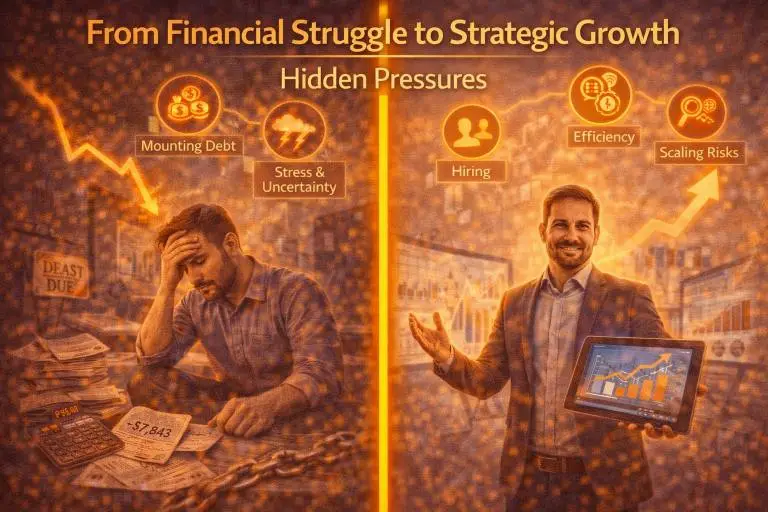


It upgrades it.
When someone tries to fix a rough season in business, new pressures don’t disappear, they evolve.
During a tough season, survival is the only focus. You’re thinking:
- How do I pay rent?
- How do I clear this debt?
- How do I keep customers?
- How do I avoid shutting down?
You act fast, cut costs and push sale. You even hustle more.
- You refresh your bank app more than usual.
- You calculate numbers in your head while trying to sleep.
- You tell yourself, “Just let this month pass.”
Then something shifts.
- Sales improve.
- Cash flow stabilizes.
- Customers return.
- The business breathes again.
You think relief will follow.
Instead… a new kind of pressure appears. Not the loud, desperate kind. But they quiet, strategic and mental kind.
Recovery doesn’t remove pressure. It upgrades it.
Let’s break down three powerful new pressures that show up when you start fixing a rough season in business.
1. Pressure of Making the “Right” Decision
• What the new challenge is
When your business was struggling, decisions were simple: SURVIVE.
Now that things are improving, every decision feels heavier.
- Should you expand?
- Should you hire?
- Should you reinvest?
- Should you increase prices?
- Should you enter a new market?
This is decision anxiety.
During survival mode, you were already at the bottom. Risk didn’t feel that scary. But after recovery, the stakes feel higher because now there’s something to lose.
You’re no longer reacting — you’re strategizing. And strategy carries mental weight.
For example:
A retail founder who just stabilized revenue from ₦800k back to ₦2m monthly hesitates to stock new product lines. They open the supplier’s message three times. They almost transfer the money and then they close the app.
Why? Because if the new inventory doesn’t move, cash flow tightens again. Awareness of consequences increases and fear of miscalculation grows.
Urgency moves fast, thinking moves slowly. And slow thinking creates pressure.
• The common mistake people make
They overthink into paralysis.
Some founders stop moving entirely.
- They delay expansion.
- They postpone decisions.
- They avoid calculated risks.
Others swing to the opposite extreme — they try to prove they’re “back” by making aggressive moves too fast.
Both extremes are dangerous.
• How to prepare for it
Create a decision framework before emotions get involved.
Ask:
- Is this decision based on data or fear?
- What is the worst-case scenario?
- Can the business absorb that loss?
- What is the small test version of this decision?
Instead of expanding fully — test.
Instead of hiring full-time — start part-time.
Instead of buying massive stock — pilot smaller quantities.
Structure reduces anxiety.
• What to expect if handled well
- You develop calm confidence.
- You stop chasing perfect decisions and start making informed ones. Your growth becomes steady, not dramatic.
- And steady businesses survive longer.
2. Pressure of Expectations after Improvement
• What the new challenge is
You fixed the problem. Now a new fear appears: “What if I lose this progress?” Ironically, improvement creates anxiety.
Instead of celebrating growth, you begin guarding it obsessively. You check daily sales more often than before.
A slow day feels heavier than it should.
• Why it appears
Because pain leaves memories. If you’ve experienced low sales, debt stress, or a near collapse, your brain doesn’t forget easily. So when things improve, your mind shifts into protection mode.
For example:
A person, who almost shut down his online store because of low sales and finally stabilizes monthly profit, will hesitate to reinvest in marketing.
They think:
- What if sales drop again?
- What if I expand and regret it?
This creates:
- Hesitation to scale
- Fear of reinvesting
- Playing too safe
- Over-controlling every small detail
The business doesn’t collapse. But it stagnates. And stagnation slowly weakens momentum.
• The common mistake people make
Shrinking after growth.
Instead of building momentum, they freeze.
- They avoid necessary risk.
- They stop innovating.
- They under-invest in marketing.
- They delay hiring support.
Safety becomes the new trap.
• How to prepare for it
Understand this truth: Progress requires reinvestment. But reinvestment should be structured. Create a growth allocation rule.
For example: Reinvest 30% of profit, Save 40% and Keep 30% for stability
The exact percentages don’t matter as much as having a rule. This removes emotional decision-making.
You’re not gambling. You’re growing intentionally.
• What to expect if handled well
You move from fear-driven management to growth-driven management.
Instead of protecting survival, you start building resilience. And your business becomes stronger, not just stable.
3. Pressure of Increased Operational Complexity
• What the new challenge is
Growth doesn’t remove stress. It changes its form. You move from revenue stress to systems stress.
Now you’re dealing with:
- Inventory management
- Delivery coordination
- Customer service volume
- Staff management
- Process organization
The money problem reduces. But operational problems increase.
• Why it appears
Because complexity rises with scale.
When you had 20 customers, you could manually respond to everyone. At 200 customers, manual systems break.
- Messages pile up.
- Deliveries get mixed up.
- A customer complains publicly.
Growth exposes weak systems.
• The common mistake people make
Trying to manage a bigger business with small-business systems.
- They rely on memory instead of documentation.
- They delay automation.
- They refuse to delegate.
- They micromanage everything.
The founder becomes the bottleneck. Stress increases again just in a different form.
• How to prepare for it
Shift your mindset from operator to architect. That’s a different kind of work.
Ask:
- What system can replace my memory?
- What process can reduce repeated questions?
- What tasks can be delegated?
- What tools can automate this step?
So you:
- Document workflows.
- Create simple SOPs.
- Use basic management tools.
- Track numbers weekly.
You are no longer just selling. You are building structure.
• What to expect if handled well
- You gain breathing room.
- The business starts running with you and not only because of you.
- Your time frees up.
- Your stress becomes manageable.
- Growth becomes sustainable.
Conclusion
Fixing a rough season in business feels like victory. But recovery introduces new pressures.
These are not signs of failure. They are signs of evolution.
The goal is not to eliminate pressure. The goal is to upgrade how you handle it.
- Survival mode builds resilience.
- Recovery mode builds strategy.
- Growth mode builds systems.
If you understand that pressure evolves, you won’t panic when it changes form. You’ll recognize it as proof that your business is no longer fighting to exist. It’s learning how to grow.