
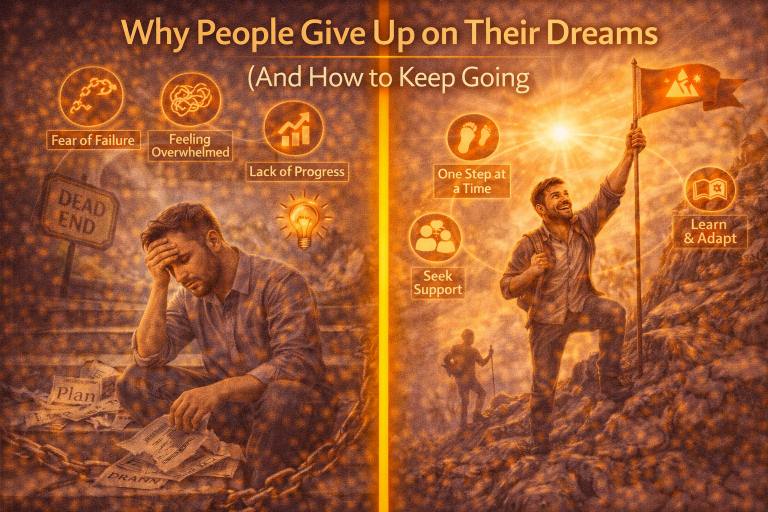
People don’t give up because they can’t succeed.
They give up because the pressure feels stronger than their progress.
Dreams are powerful.
They give direction, meaning, and a reason to endure hard seasons. Yet many people quietly bury their dreams long before they reach them.
Every successful person carries scars. Behind every visible achievement is a season when failure was closer than success, when quitting felt more logical than continuing.
They had moments when doubt was louder than hope. Still, they kept moving. They kept trying to make every moment count in their journey. Eventually, they arrived.
But for every person who reaches the destination, many stop along the way.
They do not stop because they are lazy. They stop because the pressure attached to their dream becomes heavier than they expected.
They make sacrifices, lose comfort, give up pleasures, and endure criticism. They imagine that persistence will produce quick progress. And when progress delays, discouragement grow.
When you ask them why they stopped, they will tell you they tried and tried, but nothing changed.
This is not about blame. It is not easy out there. The fact that someone dares to dream in a difficult world is already admirable. And if you feel like giving up, that feeling is human.
In the Bible, in the book of Gospel of Luke, Peter had fished all night and caught nothing. He was tired, disappointed, and ready to clean his nets. Yet he decided to try one more time. That single decision almost broke his boat because of the weight of the fish.
Sometimes one more push changes everything.
But before we talk about pushing again, we need to understand why people stop dreaming in the first place.
The Fear Hidden Inside Hope
Many people say they hope for a better tomorrow. They talk about success, freedom, impact, or financial independence. But deep inside that hope sits fear.
They hope things will change, yet they are scared of what change requires.
A better tomorrow demands risk today. It demands stepping into uncertainty, letting go of familiarity, and sometimes facing embarrassment or rejection.
So they hold onto hope in theory but avoid action in reality. Eventually, the gap between what they desire and what they do becomes too wide. When nothing changes, they conclude that dreams are unrealistic.
It was not the dream that failed. It was fear that quietly limited action.
Remedy
The solution is not to eliminate fear but to reduce its control. Fear shrinks when action becomes smaller and clearer. Instead of trying to change your entire life at once, take one uncomfortable but manageable step. Apply for one opportunity. Share one idea. Learn one new skill.
Clarity also weakens fear. When you define exactly what you are afraid of, you often realize it is less dangerous than your imagination made it. Replace vague fear with specific strategy.
Hope must be partnered with daily action. Even small action builds courage. And courage grows through movement, not waiting.
Repeated Failure and the Mind That Learns Helplessness
Failure is painful, but repeated failure can be devastating. When someone tries again and again and keeps facing disappointment, the mind begins to protect itself.
At first, a person says, “I will try harder.”
Later, they say, “Maybe this path is not for me.”
Eventually, they think, “Nothing I do changes anything.”
Psychologists call this learned helplessness. It is when the mind adapts to repeated disappointment by lowering expectations. It feels safer to expect nothing than to hope and be hurt again.
When the mind reaches that point, dreaming feels dangerous. So people shrink their goals to match their perceived control. They stop dreaming not because they lack ability, but because they are tired of emotional pain.
Remedy
The remedy here is to shift from emotional interpretation to strategic evaluation. Failure does not always mean you are incapable. Sometimes it means the method was wrong, the timing was off, or the skill level needs upgrading.
Instead of asking, “Why does nothing work for me?” ask, “What exactly failed? Was it the strategy, the execution, the environment, or my preparation?”
Break the big dream into measurable stages. Achieve small wins deliberately. The brain rebuilds confidence through evidence. When you create proof that effort leads to results, even in small ways, helplessness begins to fade.
Also, seek feedback and mentorship. External perspective can reveal blind spots you cannot see alone. Failure analyzed becomes data. Failure ignored becomes identity.
The Economy and the System
Sometimes the challenge is not internal. It is structural.
In difficult economies, opportunities feel limited. Inflation rises faster than income. Competition increases. Systems seem to reward connections more than effort. People work hard and still struggle.
In such an environment, dreams begin to look unrealistic. A person may think, “Even if I give my best, the system will not allow me to rise.”
Whether that belief is fully accurate or not, perception shapes behavior. When someone believes the system is against them, motivation weakens. They shift from ambition to survival. And survival rarely leaves room for big dreams.
Remedy
While you may not control the system, you can control your positioning within it. Study the system instead of only complaining about it. Where are opportunities hiding? Which skills are scarce? Which problems are increasing?
Economic pressure demands adaptability. Those who grow are often those who learn to pivot. Upgrade your skills toward areas with demand. Build networks intentionally. Leverage technology and platforms that reduce barriers to entry.
Instead of asking, “Why is the system against me?” ask, “How can I move intelligently within this system?”
You may not change the economy, but you can increase your value within it.
Mental Exhaustion from the Past
Many people do not give up because they lack vision. They give up because they are exhausted.
Past actions, past risks, and past sacrifices drain them. They have tried businesses that failed. They have trusted people who disappointed them. They have invested time and money that did not return results.
At some point, rest feels safer than risk.
They choose emotional stability over another uncertain attempt. Emotional drain becomes heavier than the desire for achievement. Financial stress tightens around them. Bills, responsibilities, and expectations leave little room for experimentation.
Dreaming requires energy. When energy is gone, even beautiful visions look like burdens.
Remedy
The solution here is not immediate ambition. It is recovery.
Rest is not quitting. Strategic rest restores strength. Give yourself permission to pause without labeling yourself a failure. Heal financially by stabilizing income first. Heal emotionally by reducing comparison and unrealistic timelines.
Rebuild slowly. Start with low-risk experiments instead of high-stake gambles. Protect your energy. Create routines that support mental clarity, such as reflection, exercise, or journaling.
When energy returns, dreams look lighter. A rested mind sees possibility where a tired mind sees threat.
When Hope Is Abused
From childhood, many people are told simple formulas. Work hard and you will succeed. Go to school and life will be fine. Follow the rules and everything will fall into place.
For some, these statements become promises. When reality does not match the promise, disappointment turns into bitterness.
They worked hard. They studied. They followed instructions. Yet life did not unfold the way they were told it would.
When hope feels betrayed, trust disappears. And without trust in the process, dreaming feels foolish.
So they stop. Not because they never believed, but because they believed too much without being prepared for complexity.
Remedy
The answer is not to abandon hope but to mature it.
Replace blind optimism with informed optimism. Understand that effort is necessary but not always sufficient. Success involves skill, strategy, timing, relationships, resilience, and sometimes luck.
Educate yourself beyond traditional advice. Learn how systems truly work. Study markets, human behavior, and decision-making. Build multiple paths instead of depending on a single formula.
Hope becomes stronger when it is built on understanding rather than slogans.
Conclusion
People give up and stop dreaming for many reasons.
If you have stopped dreaming, you are not weak. You are human.
But understanding why you stopped is powerful. Because once you understand the reason, you can address it.
Sometimes the difference between quitting and breakthrough is not talent. It is clarity. It is learning to manage fear, reframe failure, adapt to systems, recover energy, and rebuild hope in a mature way.
And sometimes, like Peter, it is simply deciding to try one more time.
This time, however, you try with awareness. With strategy. With renewed strength. And with a hope that is no longer fragile, but informed and resilient.
Final Word
If you are serious about growth — financial or personal — but tired of vague advice and repeated setbacks, you are in the right place.