
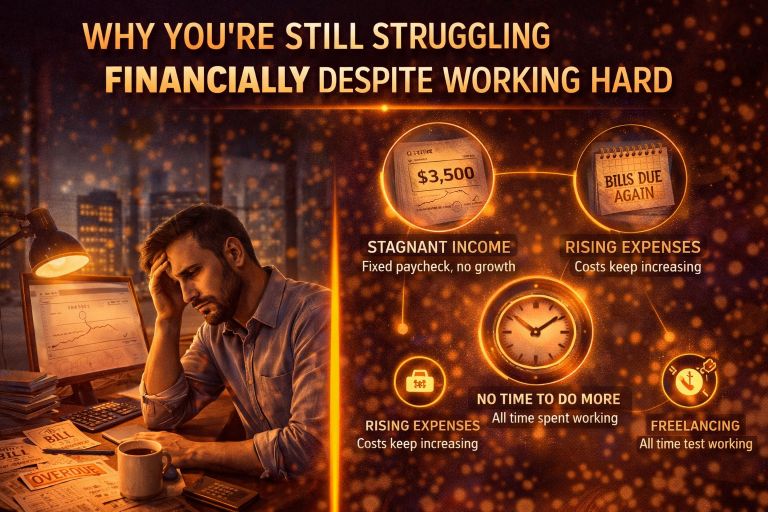
You’re struggling because the system around you isn’t designed to grow your income.
Every year, when people write their New Year’s resolutions, more than half of them are about money desire.
Desire to:
- Increase income.
- Save more.
- Clear debt.
- Start a business.
- Invest.
- Achieve financial freedom.
That alone tells you something powerful: finance is not just a topic. It is pressure, a survival, an identity and a security.
Yet the painful question remains: if we work hard every day, wake up early, sacrifice sleep, push ourselves mentally and physically… why are we still struggling financially?
- Why Does Effort Not Always Translate Into Freedom?
- 1. Rising Responsibility with Stagnant Income
- 2. Hope without a Structured Plan
- 3. Time Poverty: No Energy Left After Work
- 4. Dependence on a Single Source of Income
- 5. Survival Spending Leaves No Room for Growth
- 6. Debt
- 7. Financial Illiteracy and System Blindness
- Conclusion
- Final Word
Why Does Effort Not Always Translate Into Freedom?
The problem is not laziness. Most people are not lazy.
- The problem is structure.
- The problem is systems.
- The problem is how modern life is designed.
In this post, we will talk about the real reasons why we’re still struggling financially despite the fact that we work hard every single day to achieve financial independence.
1. Rising Responsibility with Stagnant Income
As we grow older, responsibilities increase automatically. Rent becomes bigger. Family expectations increase. Children arrive. Parents age. Bills multiply.
But income does not always grow at the same speed.
You may be earning almost the same salary you earned three years ago, but your expenses have doubled. The gap between income and responsibility becomes a silent stress that keeps widening.
Reason:
Income growth is often linear, but responsibility growth is exponential. Inflation increases costs quietly. Lifestyle upgrades creep in slowly. Promotions are not guaranteed.
Many people focus on surviving today without negotiating or positioning themselves for higher income tomorrow.
Remedy:
Income must grow faster than responsibility. That requires skill upgrading, strategic career positioning, negotiation, and sometimes bold moves.
It also requires resisting lifestyle inflation until income becomes truly stable and expandable.
Responsibility should not dictate income; income strategy should dictate responsibility.
2. Hope without a Structured Plan
Many people want financial freedom. They believe it will happen. They speak positively about it. They pray for it.
But hope without structure becomes emotional comfort, not financial progress.
Wanting to “make more money” is not a plan. Saying “I will invest this year” is not a system. Saving randomly without a target is not strategy.
Reason:
Most people are never taught how to design a financial roadmap. They operate emotionally.
When money comes, they react. When bills arrive, they react again.
There is no written structure connecting income, savings, investment, skill growth, and long-term wealth creation.
Remedy:
Financial progress requires design. Clear income targets. Clear savings percentages. Clear investment strategy. Clear skill development goals.
When money has an assigned role before it arrives, chaos reduces. Structure converts hope into measurable progress.
3. Time Poverty: No Energy Left After Work
You wake up early. You commute. You deal with customers or bosses. You handle stress. You return home exhausted.
You want to build something extra. You want to learn. You want to start a side project. But there is no energy left.
This is time poverty. You may have 24 hours, but you do not have usable hours.
Reason:
Most jobs consume mental bandwidth, not just time. Stress drains creativity. Long work hours reduce strategic thinking.
When survival takes all your energy, long-term wealth building becomes postponed repeatedly.
Remedy:
Energy management is more important than time management.
That means protecting small high-quality hours daily for growth.
It may require waking up earlier, reducing social media consumption, or restructuring work if possible.
It may also require aligning your job with a path that increases future earning power rather than only paying today’s bills.
4. Dependence on a Single Source of Income
If your entire financial life depends on one salary, you are financially fragile.
One company. One client. One paycheck.
When that source shakes, everything shakes.
Reason:
Many people focus only on stability instead of scalability. They trade time for money in one place and stop there.
There is no diversification of skills, income streams, or assets.
Remedy:
Even if you start small, build a second stream (the the first post Link here).
It could be freelance work, digital products, investments, consulting, or skill monetization.
Multiple income streams do not just increase income; they increase security and confidence.
Financial independence rarely comes from a single stream alone.
5. Survival Spending Leaves No Room for Growth
For many people, income covers only essentials. Rent. Food. Transportation. Utilities. School fees.
There is nothing left for investing. Nothing left for business. Nothing left for learning.
This creates a cycle where survival consumes everything.
Reason:
When every dollar is already assigned to basic needs, wealth-building becomes impossible.
Low income combined with rising costs forces spending into survival mode.
Financial pressure then leads to short-term decisions rather than strategic ones.
Remedy:
Growth requires margin.
If expenses consume 100% of income, change must happen either on the income side or expense side.
Sometimes that means downsizing temporarily to create space.
Sometimes it means aggressively pursuing income growth rather than cutting endlessly. Without margin, there is no momentum.
6. Debt
Debt is one of the heaviest financial anchors.
Not all debt is destructive, but high-interest consumer debt quietly eats future income. It reduces options. It increases stress. It delays freedom.
Reason:
Easy credit, emotional spending, emergencies, and lack of financial literacy push many people into debt traps. Once interest compounds, progress becomes slow and painful.
Remedy:
- Debt must be approached strategically.
- Prioritize high-interest debt first.
- Avoid new unnecessary borrowing.
- Build an emergency fund to prevent future debt cycles.
Most importantly, shift from consumption debt to asset-building behavior.
Debt repayment is not just about money; it is about reclaiming control.
7. Financial Illiteracy and System Blindness
Many hardworking people struggle not because they are incapable, but because they were never taught how money truly works.
They do not understand investing, inflation, taxation, leverage, or how systems influence income distribution. They work inside the system without understanding how to benefit from it.
Reason:
Traditional education focuses on employment, not wealth creation.
Conversations about money are often emotional or secretive.
As a result, people repeat patterns they saw growing up without questioning them.
Remedy:
Financial education must become personal responsibility.
- Study markets.
- Understand how businesses grow.
- Learn how assets generate income.
- Observe patterns.
- Decode economic events.
When you understand the system, you can position yourself differently inside it instead of being crushed by it.
Conclusion
Working hard is honorable. But hard work alone is no longer enough.
In today’s economy, effort without strategy leads to exhaustion. Income without structure leads to leakage. Responsibility without growth leads to pressure.
Financial independence requires more than motivation. It requires design, skill, margin, multiple streams, and awareness.
If we are still struggling despite working hard, the answer is not to work harder blindly.
The answer is to work smarter, structure better, learn deeper, and position strategically.
Hard work opens the door. Strategy keeps it open.
Final Word
If you are serious about growth — financial or personal — but tired of vague advice and repeated setbacks, you are in the right place.