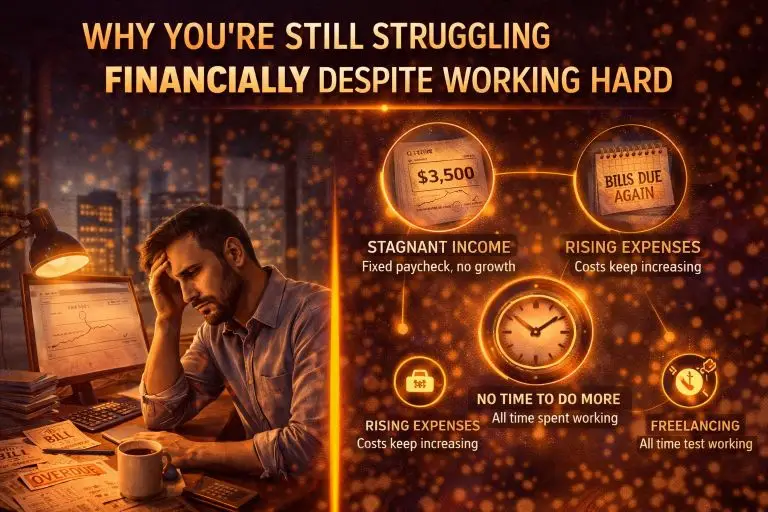


If your income doesn’t grow, your effort won’t either.
I remember a month I couldn’t ignore. Every single day, I was working.
- Orders were coming in.
- Messages were flowing.
- Deliveries were going out.
From the outside, it looked like everything was working perfectly. Even I believed it.
Until I checked my numbers at the end of the month. Revenue looked good… but the final line was red. A loss.
I went back, thinking maybe it was a mistake. But it wasn’t. The more I checked, the clearer it became: I was busy… but not profitable. And that’s a dangerous place to be.
Because one bad month can be ignored. Two months can be explained. But consistent losses? That’s not bad luck—that’s a system problem.
I’ve seen this happen not just in business, but also with career professionals. You earn monthly. You work hard. You hit your targets. But somehow, at the end of it all, nothing stays.
You start asking yourself: “Where did all the money go?”
- A fashion vendor selling consistently but barely keeping profit after restocking.
- A freelancer fully booked but still struggling to save.
- A salary earner earning monthly but ending every cycle broke.
This is not something to ignore or normalize. Your finances are not just numbers—they are your stability, your options, and your future.
And here’s the truth most people don’t realize:
Sometimes, it’s not entirely your fault.
You may be operating inside a system—a mindset, a culture, a structure—that was never designed to make you financially stable.
But the moment you start seeing it differently…
That’s where change begins.
Now let’s break down why this keeps happening.
Here Are 3 Reasons Why You Stay Busy but Still Broke
You’re doing the work, completing tasks and showing up. But the outcome doesn’t match the effort.
That’s not random. There are patterns behind it.
1. The Culture: Hustle Harder, Stay Busy, Grind 24/7
There was a time I believed the formula was simple: Work more = earn more.
So I stayed busy. I posted daily. I replied instantly. I took every order. I filled every gap with activity.
But something felt off.
The more I worked, the more tired I became… but not richer.
This problem exists because the culture rewards visibility and activity—not profitability.
You’re told to stay consistent, stay active, and keep grinding. But no one tells you to stop and ask: “Is this effort actually producing results?”
So you end up doing more of what isn’t working.
The solution is not to stop working. It’s to start working intentionally.
You need to shift from “doing more” to “doing what matters.”
This means identifying the activities that actually generate income and cutting off the ones that only create the illusion of progress.
When I made this shift, I noticed something powerful. I started doing less… but earning more. Because my effort was now focused, not scattered.
What you should expect is clarity, less burnout and more control over your time and results.
The truth is simple: Being busy is easy. But being profitable requires thinking.
2. Poor Financial Structure: Weak Margins, Bad Positioning, Ignoring Reality
I once looked at a business that was making steady sales every week.
From the outside, it looked successful. But when we broke down the numbers, we saw the truth:
After cost of goods, logistics, discounts, and small expenses… almost nothing was left.
The business wasn’t growing—it was surviving.
This problem exists because many people focus on revenue, not structure.
They ask, “How much did I make?” Instead of asking, “How much did I keep?”
And sometimes, the issue goes deeper—bad positioning.
If your product is priced like everyone else in a saturated market, your margin becomes your biggest enemy.
The solution is to build a strong financial structure.
This means understanding your margins clearly, knowing your real costs and Pricing based on sustainability, not competition.
It also means positioning your offer in a way that allows you to charge properly—through branding, value communication, or targeting a better segment of the market.
When I started paying attention to structure instead of just sales, I realized something: You don’t need more customers—you need better numbers.
The expected result is control. You stop guessing and start making decisions based on reality. Because a business that doesn’t respect its numbers will eventually collapse under them.
3. Overcrowded Market: Too Many Sellers, Price Wars, Dying Profits
I’ve seen this happen too many times.
A product starts trending. Everyone jumps in. The market becomes crowded overnight.
At first, it looks like opportunity then the competition begins and Prices start dropping.
People start undercutting each other, Profit margins disappear. And now everyone is working… but barely earning.
This problem exists because most people enter markets without differentiation.
They sell the same thing, the same way, to the same audience.
So the only way to compete becomes price.
And price competition is a race to the bottom.
The solution is differentiation.
You need to give people a reason to choose you beyond just price.
This could be through better branding, a unique offer, and improved experience, targeting a specific niche, or solving a more specific problem.
For example, instead of selling general fashion items, someone positions as “affordable premium outfits for working-class professionals.” Same product category—but different perception and audience.
When I started thinking this way, I stopped competing with everyone. And when you stop competing on price, your profit has space to grow again.
The expected result is breathing room. Better customers and stronger positioning. Because in a crowded market, clarity beats competition.
Conclusion
If you’re busy but broke, it’s not just about working harder. It’s about understanding what’s actually happening behind your effort. Because activity can hide problems. And consistency in the wrong direction leads to consistent frustration.
But once you see the patterns— the culture, the structure, the market—you stop reacting… and start controlling. And that’s when things begin to change. Not because you’re working more. But because now, you’re finally working right.
Final Word
If you are serious about growth — financial or personal — but tired of vague advice and repeated setbacks, you are in the right place.