
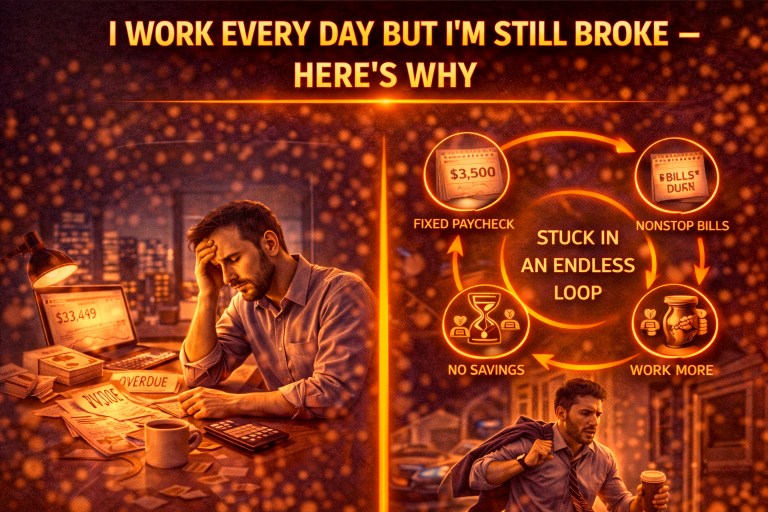
You’re stuck because the system you’re in doesn’t let you win.
I remember a moment that still sticks with me.
I was heading to a wedding in a city I had never been to before. I asked for directions, got a confident answer, and without questioning it, I moved. Fast.
I was walking with speed, purpose, and confidence. In my mind, I was making progress.
But I wasn’t.
I was on the wrong road.
The crazy part? I didn’t realize it early because everything felt right. I was moving, I was active, I wasn’t standing still. It was only after a long time—after asking another person—that I realized I had been going in the wrong direction the entire time.
I had to turn back.
That moment mirrors what’s happening to a lot of people today.
- You’re working every day.
- You’re busy.
- You’re sacrificing.
But financially… nothing is changing.
It feels like you’re running on a treadmill—moving, sweating, exhausted… but going nowhere.
And the painful truth is this: It’s not always external problems. Most times, it’s internal decisions.
Let’s break down what’s really happening.
1. Handling Too Many Emergencies
There was a period where I noticed something strange.
Money was coming in… but it never stayed.
Every week, something urgent showed up. A repair, A sudden bill, A request. A “must solve now” situation. At first, I thought it was just bad luck.
But after checking my financial records, I realized something deeper: My system was built for reaction, not stability.
The reason this problem exists is simple—there’s no buffer, No preparation, No system to absorb shocks so every small issue becomes a financial crisis.
The solution isn’t to stop emergencies—that’s impossible. The real solution is to expect them.
What is needed is a financial structure that includes an “emergency layer.” This means intentionally setting aside money regularly, even when things seem fine. It also means identifying patterns—because many “emergencies” are actually predictable.
When I started doing this, something changed. Emergencies didn’t disappear, but they stopped controlling my finances.
The expected result is stability. You stop reacting emotionally to every situation and start handling them strategically.
The truth is: if everything feels urgent, it means nothing is planned.
2. Underpricing Your Offering
I’ve been there before.
You set a price, and deep down, you already feel it’s too high… so you start justifying it to customers before they even complain.
Or worse, you reduce it quickly just to close the sale.
At first, it feels like you’re being smart—more customers, more sales.
But when you check your financial records, you see the truth: You’re working hard… but the money doesn’t match the effort.
This problem exists because of perception. Either you don’t fully understand the value you’re delivering, or you’re afraid the market won’t accept your true price.
The solution is not just “increase your price.” It’s to understand your value and position it correctly.
What is needed is clarity. You must break down what your product or service truly does for the customer.
- What problem does it solve?
- What result does it create?
- What would it cost them if they didn’t have it?
When I adjusted my pricing based on value instead of fear, something surprising happened. I didn’t lose serious customers—I attracted better ones.
The expected result is higher-quality customers and better financial returns without increasing your workload.
If your price doesn’t respect your effort, your business will slowly drain you.
3. Giving Too Much Credit to Customers
This one looks like kindness… but it can quietly destroy your finances.
I used to think giving customers time to pay was a way to build relationships. And yes, sometimes it works. But over time, I noticed a pattern. Money was “coming”… but not available.
Sales were high on paper, but cash flow was low in reality.
This problem exists because we confuse trust with lack of structure. We assume customers will always honor agreements, but without clear systems, delays become normal.
The solution is balance.
What is needed is a structured credit system. Not emotional decisions. Clear rules. Who qualifies? How long? What happens if they delay?
When I started setting boundaries, I noticed something interesting—serious customers respected it. Only unserious ones had issues.
The expected result is stronger cash flow and less financial stress.
Access to money is more important than the idea of money.
4. Doing Everything Alone — No System, No Structure
This is one of the biggest traps.
You’re always working, Always busy and Always doing something.
But at the end of the day, there’s no real progress.
I reached a point where I was handling everything—sales, communication, delivery, planning. I thought I was being productive.
But in reality, I was just occupied.
This problem exists because activity is mistaken for progress. Without systems, everything depends on your energy. And energy runs out.
The solution is structure.
What is needed is a system that allows things to run without your constant involvement.
- Processes.
- Simple workflows.
- Or Clear steps that can be repeated.
When I started building systems, I didn’t just free up time, I increased results. Because now, effort was organized.
The expected result is scalability and clarity. You stop guessing and start operating.
Busy doesn’t mean profitable. Structure is what turns effort into results.
Conclusion
If you’re working every day and still broke, it’s not always because you’re not trying hard enough.
Sometimes, it’s because you’re moving in the wrong direction with confidence.
Like that day I had to turn back, many people need to pause and ask: “Am I actually moving forward… or just moving?”
Because effort without direction leads to exhaustion, not success. And the moment you fix direction, everything changes.
Final Word
If you are serious about growth — financial or personal — but tired of vague advice and repeated setbacks, you are in the right place.