
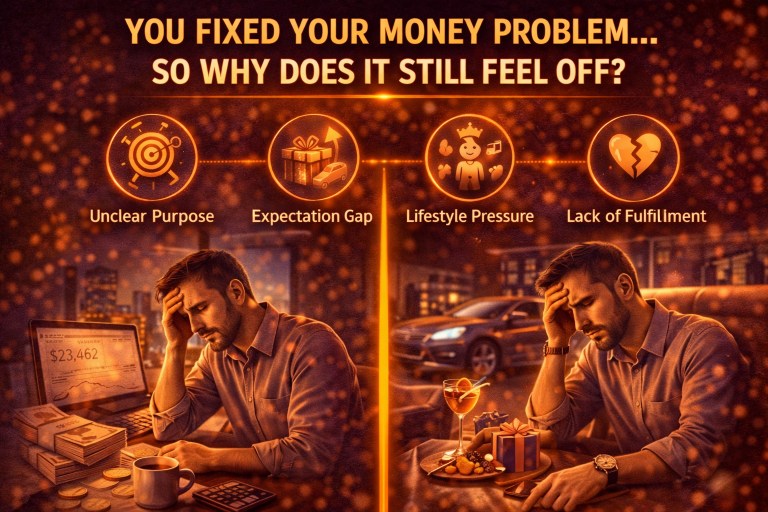
If your life has no direction, income won’t fill the gap.
I remember the phase after I finally “fixed” my money problem.
For the first time in a long while, money started making sense.
I wasn’t just busy anymore—I was seeing results. My effort was now translating into actual income. My structure improved. My decisions became clearer. And I thought to myself: “Finally… I’ve figured it out.”
But not long after that, something else started happening.
NEW PRESSURE.
Not the kind I had before but a different kind. Subtle, but dangerous.
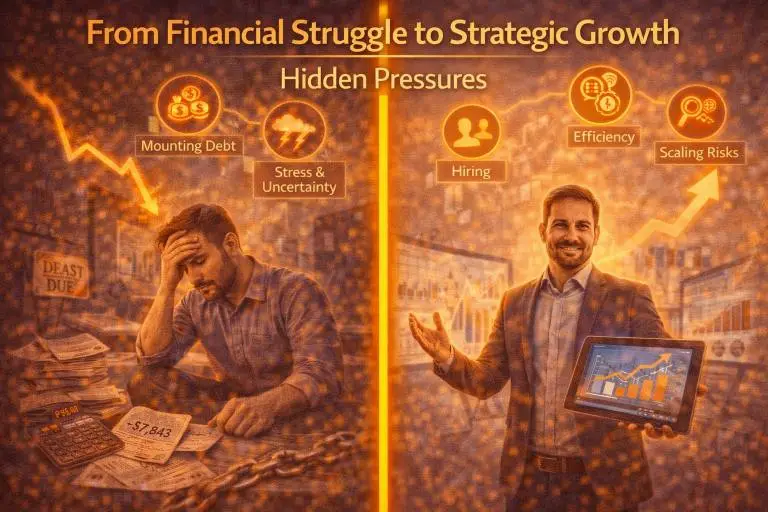
Because here’s what nobody tells you: Solving one level of financial struggle doesn’t mean challenges disappear. It only means the challenges evolve.
I started noticing new behaviors in myself—working more than necessary, becoming too comfortable at a certain level, hesitating to make bigger moves.
That’s when I realized: Growth comes with new problems. And if you don’t prepare for them, they can quietly pull you back to where you started.
So if you’ve started fixing why you were broke despite being busy, here are the next pressures you need to be ready for.
1. You Start Overworking Yourself Again
After things began to improve, I made a mistake.
I thought, “If this level of work gives me results… then more work should give me more results.”
So I increased my effort. More hours, More tasks and More involvement in everything.
At first, it felt productive. But slowly, I noticed I was slipping back into the same pattern—being busy again.
Just at a higher level.
This challenge appears because success creates momentum. And instead of refining your system, you try to multiply your effort.
The common mistake is thinking growth comes from doing more, instead of doing better. But growth at this stage requires optimization, not exhaustion.
To prepare for this, you need boundaries.
- Clear working hours.
- Defined roles.
- Systems that allow things to run without your constant presence.
You also need to constantly ask: “Is this task necessary… or am I just used to doing it?”
When handled well, something powerful happens. You earn more without increasing stress. Your business starts working with you, not on you.
The truth is: If success makes you more tired instead of more free, something is wrong.
2. The “I Have Arrived” Mentality
I experienced this quietly.
Things got better, and without realizing it, I slowed down mentally.
Not physically—I was still working—but internally, I stopped pushing for growth.
I became comfortable.
I stopped questioning things, I stopped exploring new ideas, I avoided risks that could move me forward. And now, I had something to protect.
This challenge appears because stability feels good especially after struggle.
You finally breathe. And in that moment, growth starts to slow. The common mistake is confusing progress with arrival.
You think you’ve reached a destination, when in reality, you’ve only entered a new level.
To prepare for this, you need a new standard. Not survival, Not stability, But expansion.
You must keep asking: “What’s the next level from here?”
And be willing to upgrade even when things are “working.”
When handled well, you avoid stagnation. You stay dynamic. You grow into opportunities instead of shrinking to protect comfort.
Because the moment you feel like you’ve arrived… you’ve started falling behind.
3. Fear of Bigger Moves (Playing Small Again)
This one is subtle but powerful.
As things improved for me, I noticed something unexpected:
I started hesitating. Opportunities came—expand the business, increase prices again, enter a new market—but I held back.
Why? Because now, I had something to lose.
Before, when things weren’t working, risk felt normal. But now, with some level of success, risk felt dangerous.
This challenge appears because success introduces fear of loss. You start protecting what you’ve built instead of growing it.
The common mistake is staying in a safe zone for too long.
You avoid necessary risks. You delay decisions. You shrink your vision without realizing it.
To prepare for this, you need to redefine risk. Not all risks are dangerous. Some are necessary for growth.
You also need to build confidence through data and structure—not emotion. When your decisions are backed by numbers and insight, fear reduces.
When handled well, you expand strategically. You take calculated risks that move you forward without destroying your foundation. Because staying safe for too long is its own form of danger.
Conclusion
Fixing why you were broke despite being busy is powerful. But that’s only the first stage.
Because once things start working, new pressures appear:
- The pressure to do more.
- The temptation to relax too soon.
- The fear of losing what you’ve built.
And if you’re not aware of them, they can slowly pull you back into the same cycle you just escaped.
Growth is not just about solving problems. It’s about managing the new problems that come after. And the people who keep moving forward are not the ones who avoid challenges. They are the ones who understand them early… and prepare for them before they strike.
Final Word
If you are serious about growth — financial or personal — but tired of vague advice and repeated setbacks, you are in the right place.